Open Letter: Homes for All

We are a coalition of people with lived expertise of homelessness, homeless outreach workers, community-based organizations, housing advocates, researchers, and academics.

Today is National Housing Day and we join national leaders[1] in calling on the Government of Canada to act decisively on their legal obligation to demonstrate progress on realizing the human right to housing by:

● Doubling social housing in Canada and dedicating a minimum of 50,000 net new social housing units annually for the next 10 years to be affordable to the lowest income residents of Canada, starting in Budget 2024/25.

And, we call on the Governments of Canada and British Columbia to co-operate on a new social housing strategy that will rapidly make safe, affordable homes accessible to all families and individuals with low and very low incomes and implement real rent control now.

In the 2021 Census, there were nearly 18,000 households with low and very low incomes – annual incomes lower than $42,500[2] – in the Capital Region that lack housing they can afford. This number has certainly risen as the temporary effects of the Canada Emergency Response Benefit have ended and rents have escalated steeply since then.

Housing precarity is affecting all renters in Greater Victoria. Average rents in BC cities have risen between 10 and 23 per cent each year since 2019.[3] And BC leads the country in no-fault evictions.[4] There have been some promising new initiatives announced in the past year designed to alleviate the housing crisis for middle-income households;[5] however, we sound the alarm over the lack of urgency delivering housing responses to homelessness that match the scope and urgency of this humanitarian crisis. 

We insist that you now turn your attention to developing housing policy that addresses the extreme affordability gap experienced by those facing or surviving homelessness and housing instability in BC. Meeting those needs requires a variety of subsidized social housing, new income and/or rental supplements. 

Many will not be able to permanently exit homelessness if the shelter made available to them is unsafe, unsanitary, splits up families, lacks privacy, or cultural and/or gender safety. We need Indigenous-led housing, seniors housing, veterans housing, housing that is safe for women and their children, safe housing for 2SLGBTQ+, recovery-oriented housing, housing for youth, accessible housing for people with disabilities, and housing for both individuals and families, to name a few. We explore some of these specific populations below, noting that these are only a few examples of housing inequities in our community.

We decry the rising number of seniors experiencing homelessness in Greater Victoria. Seniors now account for almost one in four homeless[6], up from approximately one in five in 2018.[7] Seniors experiencing homelessness age faster and live significantly shorter lives than their housed peers.[8] Seniors face additional age-related stigma and have unique and often unmet support needs while homeless as they age into increasing disability. This is further compacted for seniors belonging to other groups marginalized by social and economic systems. 

Indigenous people continue to be over-represented in local, provincial and national homeless counts. Indigenous Homelessness includes experiences of being disconnected from land, family, community, culture, and Indigenous identity. The definition of Indigenous Homelessness recognizes that colonialism, implemented via Canadian public policies, including the residential school system, the ‘Sixties Scoop,’ and the current child welfare system, are the most common and significant contributing factors to Indigenous Homelessness.[9]  Affordable housing is critical to ending violence against Indigenous women and girls: affordable housing was mentioned 299 times in the Missing and Murdered Women and Girls report. 

The 2023 Greater Victoria Point In Time (PiT) Count found that one third of respondents first experienced homelessness when they were a youth, and one third of youth identified as 2SLGBTQI+. More effective housing programs geared toward supporting youth, especially youth who identify as 2SLGBTQI+ are needed to prevent homelessness.

The 2023 PiT Count found that 46 per cent of people experiencing homelessness rely on provincial disability assistance. It also found that 61 per cent identified as having a mental health issue, suggesting that more unhoused people would qualify for disability assistance. In November 2023, provincial disability rates remain too low to enter the rental housing market.

The impossible math of disability assistance.

Disability income assistance rates for individuals in British Columbia in November 2023 is $1,483.50 each monthThe monthly average available rent in Victoria in October 2023 for a studio apartment is $1,800 and the average available rent for a one bedroom apartment is $2,077[10]. In other words, the rent is about 20 per cent higher than provincial income assistance. Median available rent is approximately 120 per cent of disability income.

Measly disability assistance rates are causing inflows to homelessness and making exits from homelessness impossible. Setting income assistance rates at levels that make it impossible to secure housing is systemic discrimination from governments towards people with disabilities.[11] 

To conclude, housing policies and programs that do not take into account the patterns that cause inequitable access to safe, secure homes are doomed to replicate and reinforce these patterns.

In Greater Victoria, we call on all levels of government to work together to:

  • Build 2,000 net new subsidized social homes annually – with rents geared to annual household incomes that are less than $20,000 –  annually for the next 10 years in Greater Victoria alone.
  • Enact real rent control to turn off the tap into homelessness.
  • Raise all income assistance programs to meet Canada’s official poverty line and index to cost of living increases through legislation.
  • Clarify the legal rights of tenants in transitional and supportive housing, guaranteeing tenant rights, and provide access to administrative justice and unbiased dispute resolution.
  • Create a new rent supplement or housing benefit to prevent homelessness and facilitate immediate housing stability for up to 3,000 people currently experiencing or facing homelessness in Greater Victoria.

Respectfully,

Organizational Endorsements

The Housing Justice Project
Peer2Peer Indigenous Society
MakeWay Charitable Society – The Existence Project
Greater Victoria Acting Together
BC General Employees’ Union
Alliance to End Homelessness in the Capital Region
Bridges for Women Society
Anglican Diocese of Islands and Inlets
British Columbia Nurses’ Union
Roman Catholic Diocese of Victoria
University of Victoria Nursing Student Society
Quadra Village Community Centre
Fairfield Gonzales Community Association
Climate Justice Victoria
Rabbi Harry and Congregation Emanu-El
Saint Patrick’s RC Parish
Holy Cross Roman Catholic Parish
First Unitarian Church of Victoria
Anglican Church of St. John the Divine 
Self-Management BC
Backpack Project Victoria BC
Vancouver Island PWA Society (VPWAS)
Southern Gulf Islands AIDS Society
Neighbourhood Solidarity with Unhoused Neighbours
University of Victoria Students’ Society
ACPD – Action Committee of People with Disabilities Society
Inter-Cultural Association of Greater Victoria
Sisters of St. Ann (Victoria, BC)
Fairfield United Church
Victoria Labour Council 
Broad View United Church

Individual Endorsements

Bernie Pauly, RN Ph.D, Co/led, UVIC Right to Housing Research Cluster 
Kelli i. Stajurduhar, Professor & Canada Research Chair, UVIC School of Nursing and Institute on Aging & Lifelong Health
Marshall Kilduff, Research Coordinator for Right to Housing Research Cluster, MA Student at UVic
Father William Hann, Pastor
Lisa Crossman
Alison Cameron
Tracee Szczyry
Susan Z. Martin
Bruce Livingstone
Eric Doherty, Registered Professional Planner
Sinan Demirel, Ph.D.
Brenda Henderson
Barbara Hansen
Martin Girard
Gordon Craig Miller
Joan Winslow
Joanne Fadden
Susan Coyle
Andrew Kerr
Brenda Dovick
Hanny Pannekoek
Tricia Sanders
Bob Crane
Aki Gormezano
Nathan Lachowsky
Meera Dhebar
Anthony Amato
Anya Slater
Bryan Hemingway
Ashleigh Enright
Gracia Dong
Jamie Morrison
Brian Christie
Andrea Mellor
Heather Kwan
Lauren Davey
Tyrone Curtis
Taylor Snowden
Anastasia Mallidou
Cole Kennedy
Elena Hagedorn
Simon Carroll
Susan McDaniel
Deidre Rautenberg
Heather Murphy
Bruce Wallace
Jeremy Riishede
Lexy Stewart
Patrick McGowan
Charles Perin
Cian Dabrowski
Allie Miskulin
Vanya McDonell
Mark McInnes
Theone Paterson
Marion Selfridge
Denise Cloutier
Alison Barnett
Derek Robinson, MSc.
David Kennedy
Gillian Kolla
Karen Urbanoski
Matilde Cervantes
Tina Price
Brandon Haworth
Mattie Walker
Roz Queen
Niki Ottosen
Allie Slemon
Robert Birch
Mark Stevens
Leo Rutherford
Charlene LeSage
Jessica Buss
Heather Hobbs
Kim Daly
Lynn Beak
Peggy Wilmot
Giuseppe Antonio Calenda
Lyn Clark
Kim Mackenzie
April Duffield
Cleo Philp, UVSS Director of Campaigns and Community Relations
Andrew Holeton
Laura Dale
Susan Scott
Joanne Neubauer
Erica McCollum
Murray Luft
Sonia Theroux
Andrea Clark
Stephen Tyler, Ph.D.
Kirk Mercer
Ha Na Park, co-lead minister, Broad View United
Lynne Milnes
Toni Love
Vanessa Melcosky
Rama de la Rosa, Director of Resistance Rising Choir
Jennifer Johnson, Native Artist
Michelle Ferris
Cliff Skin, Dakelh Artist
Shay Dasta
Katsiaryna Savitskaya

__________________________________________________________________________

References

[1] The Canadian Alliance to End Homelessness, REALPAC, The Place Centre Smart Prosperity Institute, Scotiabank, and the Canadian Housing Renewal Association. Extracted from https://www.nationalhousingaccord.ca/https://www.scotiabank.com/ca/en/about/perspectives.articles.economy.2023-01-social-housing-scotiabank-report.html, and https://chra-achru.ca/wp-content/uploads/2022/11/Blueprint-for-Housing_CHRA-2022.pdf

[2] Housing Assessment Resource Tool for the Capital Region extracted from https://hart.ubc.ca/housing-needs-assessment-tool/

[3]  Evaluating Prospects for Vacancy Control Policy in B.C.’s Housing Affordability Crisis extracted from https://www.tapsbc.ca/vcnow

[4] Estimating No-Fault Evictions in Canada: Understanding BC’s Disproportionate Eviction Rate in the 2021 Canadian Housing Survey. Extracted from https://housingresearch.ubc.ca/sites/default/files/2023-05/estimating_no-fault_evictions_in_canada_0_2.pdf

[5] Initiatives to encourage new construction of housing, such as missing middle initiatives, zoning reform and GST rebates on purpose built rental housing, are an important piece of the puzzle, however these initiatives are not robust enough to result in housing that is affordable or accessible to individuals or families with incomes lower than $42,500 within a reasonable time-frame or to prevent inflows or exist to/from homelessness.  See: A Human Rights-Based Calculation of Canada’s Housing Shortages: extracted from https://www.homelesshub.ca/resource/human-rights-based-calculation-canada%E2%80%99s-housing-shortages

[6] 2023 Greater Victoria Point in Time Homeless Count and Housing Needs Survey.  Extracted from https://www.crd.bc.ca/about/data/housing-research

[7] 2018 Greater Victoria Point in Time Count : A community survey of people experiencing homelessness in Greater Victoria. Extracted from https://www.crd.bc.ca/about/data/housing-research

[8] “No Home, No Place”: Addressing the Complexity of Homelessness in Old Age Through Community Dialogue. Extracted from https://www.tandfonline.com/doi/full/10.1080/02763893.2015.1055024 

[9] Towards Health and Wellbeing Through Cultural Community. Extracted from
https://acehsociety.com/wp-content/uploads/2019/06/Priority-One-Lessons-Learned-Report-Final-comp.pdf

Definition of Indigenous Homelessness in Canada: Extracted from
https://www.homelesshub.ca/IndigenousHomelessness

[10] Extracted from https://www.zumper.com/rent-research/victoria-bc

[11] Housing Discrimination and Spatial Segregation in Canada. Extracted from https://housingrights.ca/wp-content/uploads/SRAH-Submission-Discrimination-and-Spatial-Segregation-in-Canada-CERA-NRHN-SRAC-May-2021.pdf
Donate to NSUN through PECSF!

Are you a B.C. public service employee? Donate to NSUN through PECSF!

Why PECSF?

The Provincial Employees Community Services Fund (PECSF) is the Province of British Columbia’s workplace giving program. The PECSF campaign runs every fall – this year from September 27 to November 10 – and has raised over $50 million for registered charities.

During the campaign period, provincial public service employees can pledge to make a one-time donation or sign up to donate a portion of every paycheque in 2024 to a charity of their choice.

This is the real value of PECSF.

Because the PECSF campaign team does the administrative work to process donations, charities can focus on impact. And because a paycheque deduction provides steady revenue, charities can plan and operate with more certainty.

How to donate

This year, consider donating to NSUN and encourage your friends and family to donate too!

The Fairfield Community Association of Victoria is a registered charity that generously accepts donations on our behalf.

To donate to NSUN via PECSF:

1) visit the PECSF website and select “donate now” or go through Employee Self Serve
2) select “Fairfield Community Association of Victoria” AND
3) in the open field marked “Specific Community or Initiative (Optional)” write “Supporting unhoused people in the community – NSUN” to ensure your donation is allocated to our work.

NSUN is volunteer-run, so 100% of your donation will support unhoused neighbours in the Victoria area.

Thank you for your generosity!

Ask City Council to act on Federal Housing Advocate’s Report and Recommendations for B.C.

NSUN and other local organizations were thrilled to meet with federal housing advocate, Marie-Josée Houle, she visited Victoria in 2022. Her fact-finding tour focused on the right to adequate housing for First Nations, Inuit and Métis peoples, encampments, and the financialization of housing.

The resulting report draws on the knowledge and insights of those with lived experience and advocates, and makes 27 recommendations related to:

1. Security of Tenure
2. Availability of Services, Materials, Facilities and Infrastructure
3. Affordability
4. Habitability
5. Accessibility
6. Location
7. Cultural adequacy

Read the report on the Canadian Human Rights Commission’s website.

Why B.C.?

Despite progressive housing policies and positive steps to curb the financialzation of housing, the report states: “B.C. faces grave violations of the right to adequate housing that require immediate attention. For example, in the Downtown Eastside of Vancouver and other downtown areas with concentrations of unhoused people, there is a lack of habitable conditions in emergency and supportive housing buildings, growing encampments across the province, the privileging of housing as a commodity for profit over housing as a place to live, and a severe lack of affordable housing.”

Houle went to Stadacona Park while in Victoria and chatted with campers sheltering there. She also connected with Dr. Bernie Pauly, well-known advocate for the homeless in Victoria and scientist at the Canadian Institute of Substance Use Research (CISUR), as well as representatives from the Greater Victoria Coalition to End Homelessness (now known as the Alliance to End Homelessness in the Capital Region), service providers from the Cool Aid Society, and other organizations and people with lived and living experience of homelessness.

What You Can Do

We encourage you to read and share the report with your network. It will give readers a much better understanding of what it is like to be homeless or precariously housed in Victoria and other areas of B.C.

You could also share the report and recommendations with the Mayor and Council, and ask what actions they will take to address the issues raised.

  1. Copy and paste the following list of names into the To: field of a new email: ccoleman@victoria.ca, Dave.Thompson@victoria.ca, jcaradonna@victoria.ca, kloughton@victoria.ca, mayor@victoria.ca, mdell@victoria.ca, mgardiner@victoria.ca, shammond@victoria.ca, skim@victoria.ca (optional cc: neighbourhoodsun@gmail.com)
  2. Put in the subject line “Recommendations from the Federal Housing Advocate’s Observational Report – August 2023”
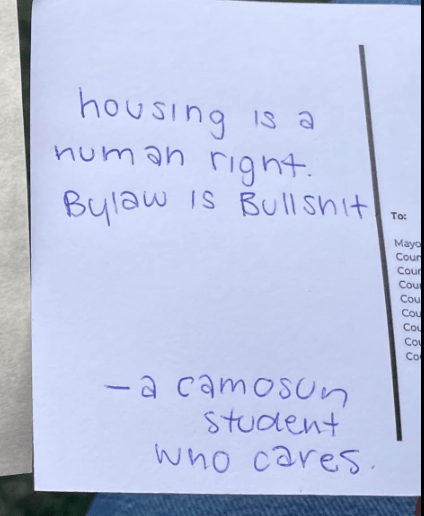
  3. Use the suggested email text and screenshots below, or write your own message in the body of the email, and send.

Message 1:

Dear Mayor and Council:

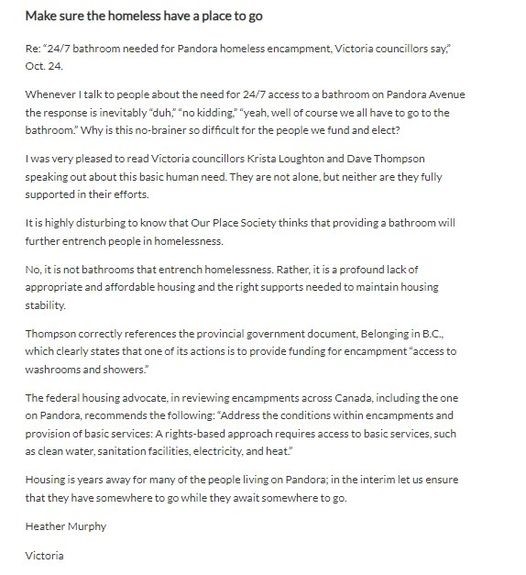
People currently sheltering in parks and along Pandora Avenue need to have basic services like those of us with homes, including clean water, sanitation, electricity and heat.

When will the City of Victoria be enacting the recommendation on the availability of basic services on page 49 of the B.C. Observational Report from the Office of the Federal Housing Advocate?

Message 2:

Dear Mayor and Council:

The City of Victoria bylaw officers, accompanied by police, persist in harassing people sheltering in parks and confiscating their belongings, including food and survival items like tents and sleeping bags. This is often for minor infractions of the 7-7 bylaw, or simply for not moving quickly enough to take down their tents in the morning. This is a violation of people’s human rights and does NOTHING to help them move out of homelessness.

I would like to know, when will the City of Victoria enact the recommendation on security of tenure on page 48 of the B.C. Observational Report from the Office of the Federal Housing Advocate?

Message 3:

Dear Mayor and Council:

One of the recommendations from the B.C. Observational Report from the Office of the Federal Housing Advocate is to enact the following on security of tenure:

The protocol (PDF) was written by Kaitlin Schwan, Lead Researcher for UN Special Rapporteur on the right to adequate housing, and Leilani Farha, UN Special Rapporteur on the right to adequate housing (2014-2020), and offers detailed and concrete methods for creating encampments that are designed with a human-rights based approach in mind.

I believe it would be in the interest of both the City of Victoria and unhoused people for the City to adopt this protocol. Is this something you are planning to do?

If so, I would appreciate a response with more information and your proposed timeline. If not, I would appreciate an explanation as to your decision and more information on how you will support unhoused people in our city in the midst of the affordability crisis.

The suggested emails above could also be modified and directed to provincial government officials like the Minister of Housing, Ravi Kahlon (HOUS.minister@gov.bc.ca) and/or Premier David Eby (Premier@gov.bc.ca).

NSUN Summer Closure

NSUN is taking a break from regular meetings for the summer.

We held our last formal meeting on May 31 and will return in September. Stay tuned to learn when meetings will restart and drop us a line through our contact form or by emailing neighbourhoodsun@gmail.com if you’d like to be notified when we restart.

Our decision to shut down for the summer was inspired by NSUN member and The Backpack Project founder, Niki Ottosen, who does so every summer for her organization. We haven’t been going nearly as long as Niki, but since our founding in October 2020, we have met for hundreds of hours. We met online weekly until June 2021, and bi-weekly from then on.

In 2023, we started gathering data a more formally and so we can share that from January to May 2023:

  • We served a total of 327 breakfast sandwiches, along with steaming cups of coffee, in the final three months of our breakfast program (January 136, February 107, and March 84).
  • NSUN members participated in about 225 hours of meetings over that time period, including 104 hours for NSUN meetings, 90 hours for The Shift project planning meetings, and 25 hours for meetings with other organizations, such as the Point in Time homeless count mapping committee and the System Transformation Working Group (comprised of representatives from BC Housing, various service providers and organizations like The Alliance – formerly the Greater Victoria Coalition to End Homelessness).
  • Collected a total of 154 submissions – both the long housing submission and the shorter encampments submission – for the Office of the Federal Housing Advocate (see post on The Shift Project).

This list doesn’t capture the hours spent in the parks or all the behind the scenes efforts when a call goes out for tents, sleeping bags or other items that someone in a park needs. These immediate needs are often because bylaw of enforcement actions that result in people’s belongings being impounded or thrown out.

The constant harassment by City of Victoria bylaw officers enforcing a punitive 7:00 a.m. to 7:00 p.m. camping bylaw is helping no one. It is expensive, frequently arbitrary, has no accountability (bylaw officers do not itemize what they are taking thus the person having their things impounded has no evidence as to what was taken), harmful, and creates a mountain of material that goes to the landfill in a city that is trying to become ‘zero waste’.

NSUN members also spend time helping unhoused neighbours try to get ID or confirming they are still on the BC Housing list and other tasks that by rights should be handled by government agencies or are, in the case of the maintenance of the BC Housing list, simply pointless bureaucracy.

NSUN members will continue to do many of these tasks during the summer closure as it’s just formal meetings that are being put on hold. We’re also hoping to have some fun over the summer too and are planning to celebrate some birthdays in Stadacona Park.

In the fall, we’ll resume our bi-weekly meeting and continue pressing the city to make sure that they have plans for the winter’s extreme weather response before it gets cold and asking what they plan to do as an alternative to the daily bylaw sweeps if they refuse to amend the camping bylaw to allow people to leave their tents up all day.

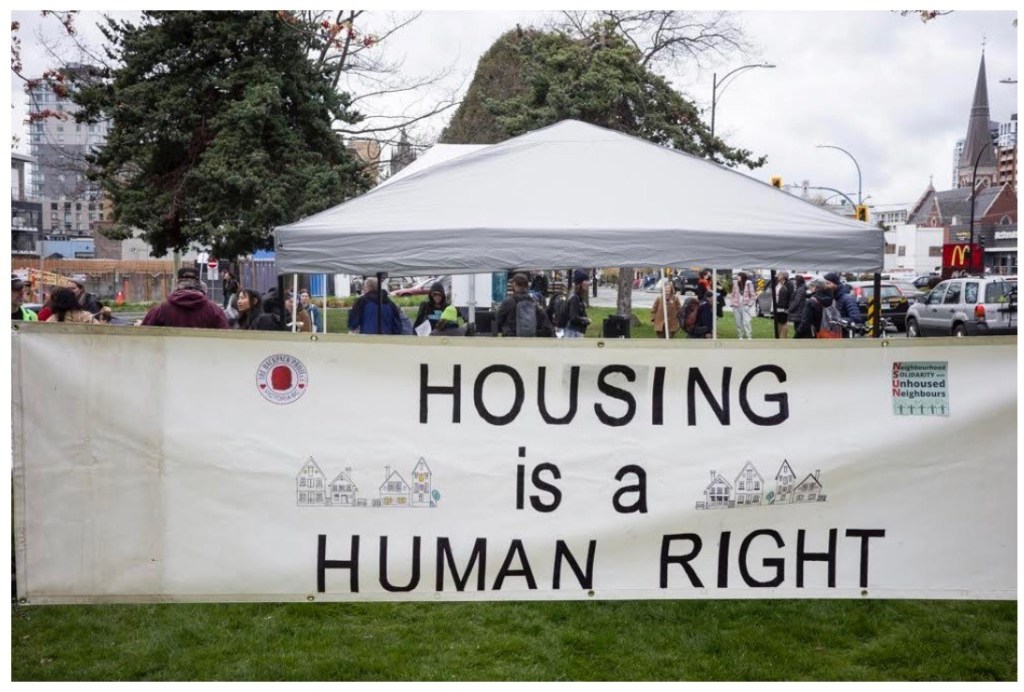
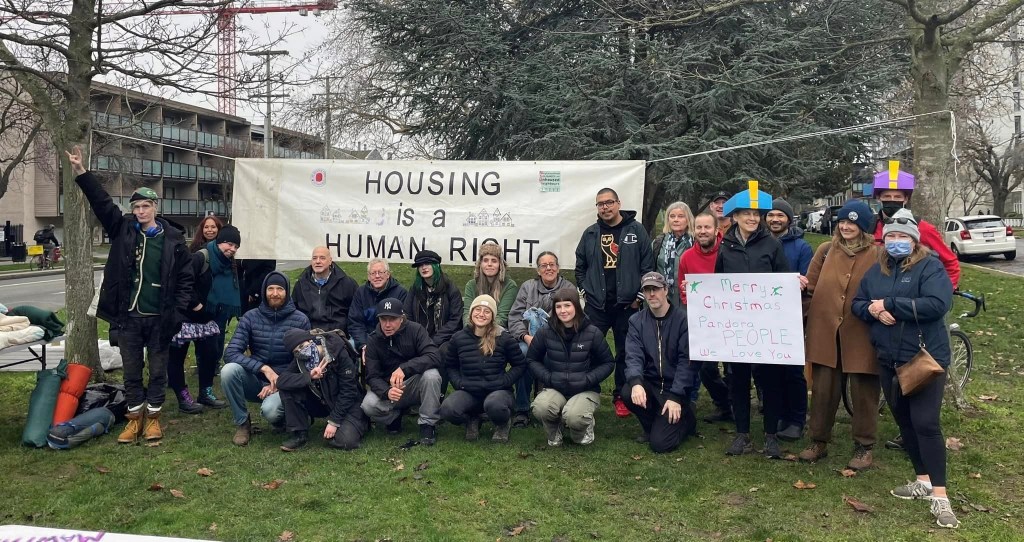
And we will always reiterate the message that housing is a human right, that unhoused people are rights-holders, and the constant and inhumane violations of their human rights must stop.

154 submissions sent to Housing Advocate through successful joint project

Planning the project with The Shift

Since fall 2022 NSUN, along with members of the Living/Lived Experience of Homelessness Network (LLEOHN), The Backpack Project, and the Peer2Peer Indigenous Society, have been in discussion with an organization called The Shift around doing a project in Victoria.

The Shift is an organization helmed by Leilani Farha, the UN’s Special Rapporteur on Housing from 2014-2020. Farha is a human rights lawyer by training and started The Shift in 2017 with the UN Office of the High Commissioner for Human Rights and United Cities and Local Government. Farha is also “the central character in the documentary PUSH regarding the financialization of housing “.

In summer 2022, The Shift approached grassroots groups working on homelessness in several cities across Canada. Here in Victoria they timed their visit to coincide with a visit by the newly appointed Federal Housing Advocate, Marie-Josée Houle. Representatives from The Shift, as well as Houle and local members of her team, met with folks from NSUN, LLEOHN, The Backpack Project, and others with lived and living experience of homelessness.

In the fall, we began discussions with The Shift about a project that would see NSUN and other groups support people with experience of being unhoused (either currently or previously) make submissions about their experiences to the Office of the Federal Housing Advocate (OFHA). We spent a lot of time that fall figuring out how to do this work.

Gathering insight from those with lived experience

Finally, in March 2023 the Housing Submission went live on the OFHA website and we were off!

Among ourselves we had whispered the goal of 100 submissions, but it was such a long road to getting started that we didn’t really think that this was obtainable.

Our first couple of events were small and gathered less than 10 submissions at each. That all changed on April 14, when we had a fantastically successful event where we collected 27 submissions. Another big event on Pandora Avenue on April 21 garnered 79 submissions, far exceeding our goal of 30. And then at our final submission event at Topaz Park on May 12, we collected 14 more submissions. We also held a roundtable discussion event May 26th that garnered more policy-focused information.

Along with submissions collected one-on-one, we have sent a total of 154 submissions to the OFHA!

The original deadline for submissions was May 26, but that was extended to June 20, and our group of collaborating organizations will continue to collect submissions until then.

Insights will inform report recommendations

The submissions to the OFHA will go into a report that the Advocate will produce with recommendations for the federal Minister responsible for housing. This will likely be out in fall 2023.

NSUN thanks all members that were involved in the project, as well as the other organizations that came together and worked so hard to make this project such a huge success.

And of course our most sincere thanks go to all those with lived and living experience of homelessness who shared with us so genuinely. They are the real heroes of this story.

Friend of NSUN talks to Mayor and Council About Inhumane Treatment of the Unhoused by Bylaw

Friend of NSUN, Jeff McEown (husband of breakfast crew member Helen), gave a stirring and powerful address to Mayor and Council on March 9, 2023, about the inhumane treatment of the unhoused by the City’s bylaw officers.

See the video beginning at 14:46: https://pub-victoria.escribemeetings.com/Players/ISIStandAlonePlayer.aspx?Id=1c772d0c-358b-4cb9-b79e-d6447889c60f.

NSUN Breakfast Program

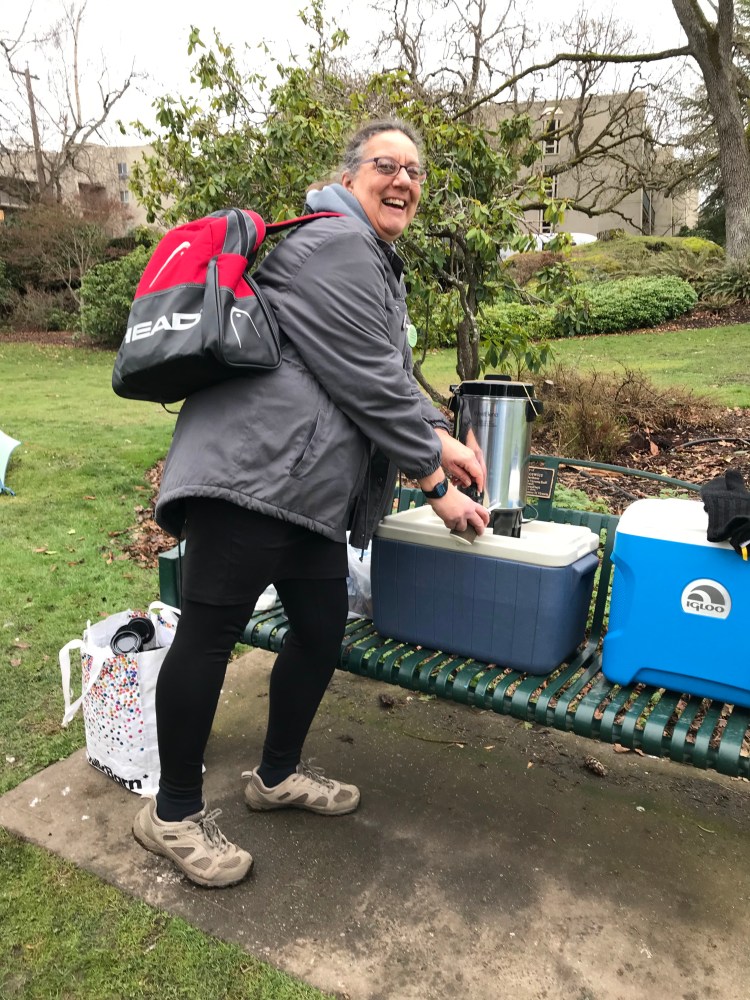
The NSUN breakfast program is the brainchild of one of our members who enjoys helping people in a very concrete way – with hot coffee and a hearty, homemade breakfast sandwich on Sunday mornings.

Since November 6, 2022, the ‘breakfast program crew’ (usually NSUN members Heather, Helen and Susan) have gone out – rain, sun or snow – to deliver as many as 30 breakfast sandwiches and coffees to those camping in Stadacona and Topaz Parks. This has proved to be a great way to build new and strengthen existing relationships with campers and stay in touch with them and their evolving needs and concerns.

NSUN has learned that most campers like lots of sugar and cream with their coffee (in fact, one camper just says that she’d like a cup of milk and sugar with a splash of coffee!) and that the friendly conversation and consistency is almost as welcome as the coffee and food.

The plan is to continue the program until the last Sunday of winter (March 19, 2023) but the crew will consider whether to extend that based on the weather forecast for late March/early April.

Susan of the breakfast crew preparing a coffee for a camper in Stadacona Park.

Call to city council to end bylaw enforcement during Emergency Weather Response

One of our members spoke to the Victoria City Council on February 9, 2023, about the confiscation of unhoused folks’ tents and belongings by bylaw officers when the Emergency Weather Response (EWR) is active and the need for trauma-informed outreach.

Many people living on our streets and in our parks are hesitant to use EWR shelters because they can’t bring their tents and belongings with them. If they do stay in a shelter, they may have their belongings confiscated as “abandoned” if left in the parks. Victoria bylaw policy is enforcement-focused, so people with very few resources are having everything they own – including tents, clothing, food, blankets, and personal belongings – confiscated or thrown away. This is harmful to citizens and is a violation of the Charter of Human Rights and Freedoms.

Watch the video presentation starting at 25:40.

Washrooms needed for people living on Pandora Ave

One of our members spoke to the Victoria City Council on January 12, 2023, about the need for 24-hour washroom access and other supports to improve sanitation and safety for people living on Pandora Ave. She called on Council to take three important actions.

Watch the presentation starting at 14:40: https://pub-victoria.escribemeetings.com/Players/ISIStandAlonePlayer.aspx?Id=fdff5deb-9294-4da7-b00a-e2ecafc5a794.