Support your Unhoused Neighbours this Winter

This post is intended as a companion piece to the article in the latest issue (December, January, February) of the Fairfield Gonzales Community Association The Observer newspaper (available online and on paper at the FGCA Centre at 1330 Fairfield Road) – simply click on the topic that you are interested in from the list below and you’ll be taken directly to details on that topic as well as links to more information.

Our campaign this winter is raising funds and/or donations of items for the following four organizations:

  1. QomQem Coastal Connections – you can donate directly to QomQem and get a charitable tax receipt
  2. Peer2Peer Indigenous Society – Peer2Peer does not have charitable status so if you’d like a tax receipt you can go to the FGCA Canada Helps page, select #3 in the drop down list and we’ll turn your donations into whatever Peer2Peer tells us is most needed for their street outreach
  3. SOLID Outreach – SOLID does not have charitable status so if you’d like a tax receipt you can go to the FGCA Canada Helps page, select #3 in the drop down list and we’ll turn your donations into whatever SOLID tells us is most needed for their street outreach
  4. The Backpack Project – the Backpack Project does not have charitable status so if you’d like a tax receipt you can go to the FGCA Canada Helps page, select #3 in the drop down list and we’ll turn your donations into whatever the Backpack Project tells us is most needed for their street outreach.

    If you’re interested in taking donations directly to The Backpack Project you can leave items at any one of the following bin locations and here’s a list of what is accepted and what is not Donation bins are available until December 20th (if you are reading this after this date please consider making a monetary contribution via NSUN and we will talk to Niki from the Backpack Project to see what is needed – January and February are still cold and miserable for those living unsheltered).

Here are links to the learning resources mentioned in The Observer article:

  1. Report from the Housing Justice Project evaluating housing in the Capital Regional District “using International Human Rights Standards and the right to housing set out in Canada’s National Housing Strategy Act 2019.”
  2. A link to the University of Victoria’s free online course “Fundamentals for the Homelessness Serving Sector

Thanks for taking the time to read this post and if you’d like to get in touch use our contact form.

IPAC Pitch Competition

On June 27, 2024, I participated in a pitch competition offered by the Institute of Public Administration Canada (IPAC). The topic of the pitch competition was Housing and Homelessness: Community Solutions. We only had 3 minutes to speak and we could use a single slide (here’s an image of mine below).

I’ve created a movie that gives more context than I could give in the presentation and there’s also a PDF of the slides within the movie that contains links to all the things I mention in the movie.

I’ve reproduced the text of my talk below and it is also available as a PDF.


Housing is the solution to homelessness – but homes that most of us can afford are not being built in Victoria at anywhere near the speed that is needed.

Instead of talking about housing tonight I am going to speak about how to better support unhoused people during their long debilitating wait for a home.

Options for where to live in Victoria if you are unhoused are steadily decreasing.

In just over a month, Irving Park and Vic West Park will close to overnight sheltering, leaving only 3 parks available where this is permitted in the city.

A campaign of bylaw sweeps displaces people frequently and causes immense suffering and harm. Where are unhoused people supposed to go?

Housed people would probably respond they could go to shelters but these facilities are often the last resort for many unhoused people-  they are often full to capacity, unsafe for women and gender diverse people, lacking in privacy and cleanliness, places where violence and theft are disturbingly common, and some even require you to vacate the premises during the day.

Additionally, often neighborhoods where such shelters and other homeless serving facilities are located are those that are less affluent and have a higher proportion of households that rent and residents who identify as a visible minority. This breaks the rule of neighbourhood development from Chuck Marohn of strong towns which I have up here on the slide. It’s inequitable and unfair and not surprisingly can cause a lot of resentment and people who are living in or using the services of such facilities feel unwelcome.

The Housing in a hurry initiative addresses these problems by creating micro scale clusters of no more than 5 sheds on available land, whether it be vacant or city owned, in multiple neighbourhoods. These sheds are about the same size as the units at Caledonia Place though at $1,500 each they are much less expensive and quicker to erect. Sanitation and power can be quickly and inexpensively deployed using ready made and locally sourced solutions that will also be climate friendly.

The next step for this initiative would be to run it by people with lived and living experience of homelessness and ask for their feedback and comments.

I acknowledge that this initiative is a departure from the usual top-down large-scale approach and in that I believe lies both its challenges – it will be a lot of work – and its potential to create a truly community-led, person-centric intervention that can create a durable solution to the challenge of keeping unhoused people safe and well while they wait for housing and also creating a more positive experience for the housed neighbours around them.

Impressions of 953/959 Balmoral

On Tuesday, June 25, 2024, Neighbourhood Solidarity with Unhoused Neighbours members were invited to tour the newly opened supportive housing building at 953/959 Balmoral (which I now know has been named The Lily). This is a report from one of the NSUN members who toured the building.

This building was originally scheduled to open in ‘summer 2022’ (see https://ehq-production-canada.s3.ca-central-1.amazonaws.c…) making it almost 2 years late – and this despite the fact that this is a modular build which I thought might make it faster.

What I liked:

  • The room that I could see off of the entry way didn’t look to be as ‘surveillance-y’ as some as I have seen that have a wall of monitors each showing several camera feeds
  • The individual rooms were more spacious than I expected and were light and airy with very high ceilings
  • There didn’t seem to be cameras apparent (one at the entry but I didn’t see any on the floors though I didn’t look carefully – I didn’t see any in the stairwells though I only went down one floor)
  • Drains built into the floor in both the bathroom and kitchen and flooring that curves up onto the wall so there are no crevices for dirt to lodge in (so smart!)

What I didn’t like/was disappointed in:

  • No air conditioning on any floor above the first – it’s great to have big windows for light but that also means heat (though there are blinds) – sadly ironic that this building is opening on the third anniversary of the heat dome that killed 619 people in BC – I think it is unconscionable to put up a brand new building without air conditioning
  • No oven – again, not a deal breaker for many I am sure but it would be nice to have some units with them so perhaps those that might want to bake or roast a turkey at Thanksgiving could ask for one of those rooms
  • No bathtub – this wouldn’t be a deal-breaker for me but I know many people find baths really soothing and good for destressing

Overall I think it looked pretty good and occupancy is supposed to start in 2 weeks. Of course the system is so choked with people waiting that there is little to no chance that anyone from an encampment will get in there – rather people who are in shelter/transitional units will be the priority. I hate that we operate from a scarcity mindset where it’s kind of dog-eat-dog in the waiting line for housing.

Some pictures below.

View out the window – this room is on the second floor. Windows do open which is nice.
Two burner cooktop and no oven. In wheelchair accessible units there is no cupboard under the cooktop.
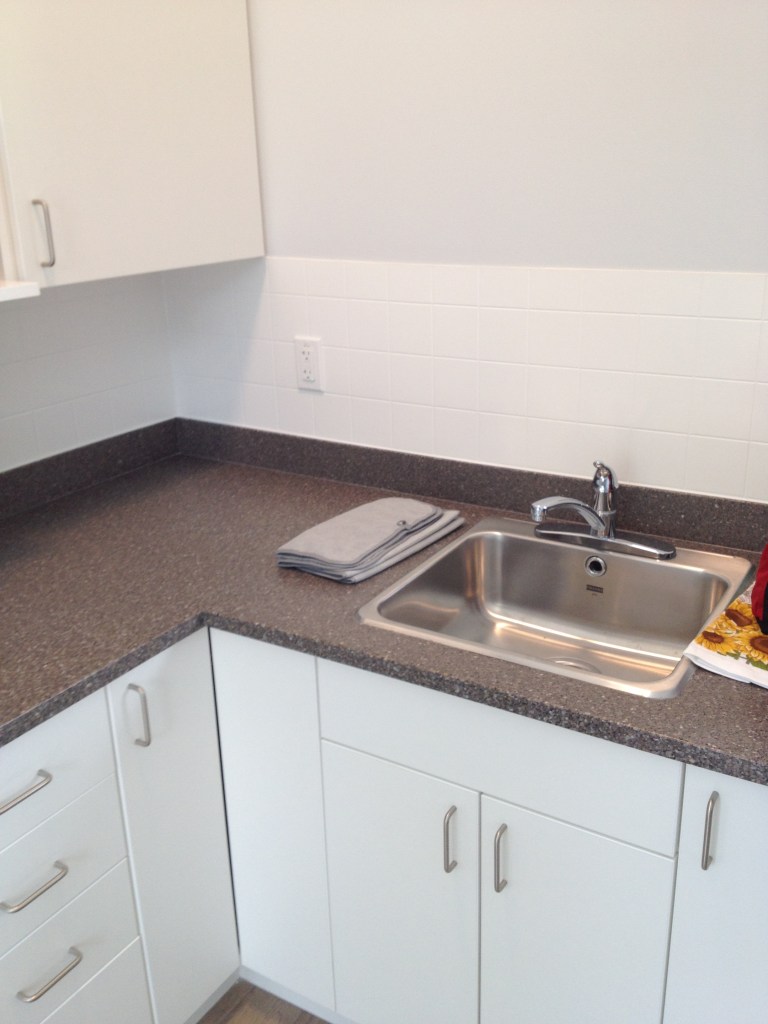
Single sink – but hey, I live in market rental and I have a single sink (but still covet double sinks something awful).
Shower is spacious, clean and bright and very easy to keep clean as it is a single insert (smart!). Fair amount of storage for towels etc.

NSUN on a summer break – but still lots of action around homelessness!

Just a heads up that NSUN is on a summer break from formal meetings for June, July and August 2024. We’ll resume meetings in September.

However there is still lots going on in terms of homelessness issues and activities to support unhoused and other groups during the upcoming weeks. First we must talk about June 15, 2024 – this is the date by which City of Victoria staff are supposed to “identify at least three indoor or outdoor locations, excluding parks, where sheltering could be permitted, and report back to Council before June 15 with the sites” (from page 8 of the minutes of the April 18, 2024 COTW meeting). It is also roughly the date when the Federal Minister of Housing (Sean Fraser) is bound to respond to the Final Encampment Report from the Office of the Housing Advocate and its finding (though the government has until August 31, 2024 to come back with a plan for encampments).

Closer to home check out these activities and see if you’re inspired to help out/donate/participate at any of them:

  • Pancakes every Monday morning at 10:30 am until they’re gone at the SOLID warming facility (926-930 Pandora) – put on by the fine folks at QomQem
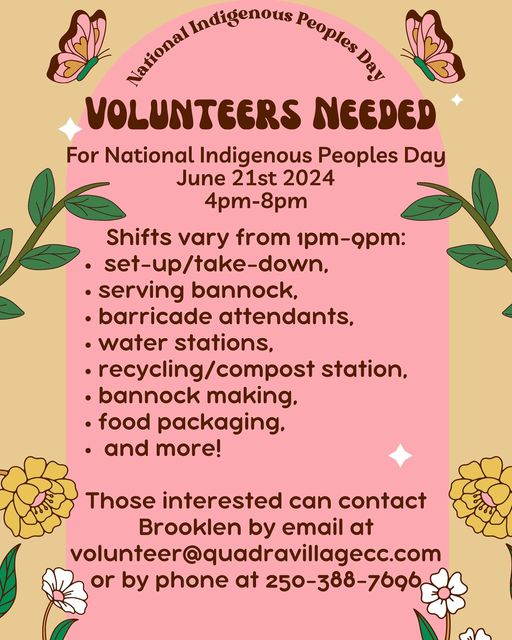
  • National Indigenous People’s Day – June 21, 2024 – volunteers needed from 1:00-9:00 pm – in Quadra Village (see screenshot below and email volunteer@quadravillagecc.com)
  • Pandora Day (a collaboration between the Victoria Downtown Residents Association, NSUN and other organizations) still somewhat tentative at this point as we’re waiting to hear about the success of some funding applications but save the date of August 8, 2024 – volunteers will be needed to help with activities such as: setting up and taking down chairs, tables, canopies, serving food and clean-up, and engaging in conversation with housed and unhoused participants (event will run from ~5:30-8:30 pm)
  • August 31st Moms Stop the Harm event recognizing International Overdose Awareness Day at BC Legislature

We’ll update this list as more things are added. Hope to see you out and about in Victoria this summer – look for folks wearing buttons with the NSUN logo and introduce yourself!

Housing Justice Project Report Release Event

NSUN was honoured to be asked to support the Housing Justice Project group as they spoke to the media and the public from the steps of the Legislature on May 7, 2024. They released their comprehensive report Homes for All: Evaluating the Right to Housing in Victoria, spoke about their personal journeys of homelessness and clearly laid out their 8 calls to action.

Calls to Action from the Housing Justice Project:

  1. There must be direct and meaningful involvement of people affected by homelessness as partners and in employment roles.
  2. Until there is adequate housing for all, end displacement of people living outdoors. Work with people in encampments to protect their human rights and provide basic services such as running water, electricity, bathrooms, sanitation, and garbage disposal. Stop Displacement, Stop the Sweeps.
  3. Eliminate long-term stays in shelters by moving people into permanent housing within 30 days.
  4. End evictions from transitional programs into homelessness. Move people directly from homelessness or transitional programs into permanent, adequate housing that costs no more than one-third of income, or the shelter rate with security of tenure.
  5. In Greater Victoria alone, we need 2,000 net new deeply subsidized and shelter-rate homes constructed annually for the next 10 years to prevent and end mass homelessness in our region.
  1. Provide everyone who is exiting homelessness with adequate housing as defined by The Housing Justice Project. Adequate housing aligns with human rights, and includes security of tenure which cannot be found in program agreements.
  2. Reconciliation includes ending homelessness for Indigenous people with Indigenous-led housing and culture as healing.
  3. We need rental supplements that are easy to access and are enough money to rent an apartment in the market.

NSUN members Heather (far left) and Susan (far right) help hold sign at the Legislature on May 7, 2024

Photo above from the CHEK news article on the event.

NSUN Members Address Mayor and Council

On April 11, 2024, six speakers – three of who are members of NSUN – addressed the City of Victoria Mayor and Council around various issues associated with the homelessness crisis. In the list below are links to individual posts for each of the NSUN speakers as well as a note of when Bernice and Diana’s addresses begin in the video.

Susan Z. Martin Addresses Mayor and Council – April 11, 2024

NSUN member Susan Z. Martin spoke to council about the slow pace of housing construction for those most in need in the CRD and what NSUN sees as a viable and quickly available alternative – sanctioned encampments. See Susan’s address beginning at about 38:35 minutes into this video. The text of her address is here. Resources that you might find helpful are shown in the list below.

Memorandum of Understanding Between the City of Victoria and the Province

“This MOU has been developed to recognize the parties’ shared purpose of supporting people in encampments and the unsheltered through commitment to implement HEART and HEARTH, a coordinated approach to resolution of encampments that prevents entrenchment, improves health and safety, preserves dignity for homeless encampment residents, respects the need for culturally appropriate services for Indigenous peoples, and considers the needs of the surrounding community.”

Office of the Federal Housing Advocate – Final Encampment Report

“… the Federal Housing Advocate launched a systemic review of encampments in February 2023. This systemic review has been carried out pursuant to subsection 13.1(1) of the National Housing Strategy Act.
In October 2023, the Advocate published an interim report setting out the context of the crisis and documenting in detail what had been heard through the engagement process. The engagement process consulted directly with people living in encampments, local community advocates, Indigenous governments and representative organizations, and duty-bearers across all governments.
This final report includes the Advocate’s conclusions about the factors leading to the rise in
encampments and, most importantly, the concrete measures that must be taken by all governments to fulfill their human rights responsibilities in order to reduce or eliminate the need for encampments.” (page 5 of the report)

940 Caledonia Reports

940 Caledonia was a sanctioned encampment that existed for a few months (Dec. 2020 to March 2021) at 940 Caledonia. There is a summarized and condensed report (14 pages) available as well as a much more comprehensive report (138 pages!) that is full of details and helpful information that the present Council and city staff would do well to review.

940 Caledonia Movie

Mindfuel Films, which includes now Councillor Krista Loughton, made the movie 940 Caledonia about the experiences of the people who were tenting in Central Park and after being flooded out of that space set up the sanctioned encampment at 940 Caledonia. The movie’s trailer is available for viewing.

A National Protocol for Homeless Encampments in Canada

This 40-page document was developed relatively early in the pandemic (April 2020):

“As encampments increasingly emerge across Canada, there is an urgent need for governments to interact with them in a manner that upholds human rights. This Protocol, developed by the UN Special Rapporteur on the Right to Housing and her lead researcher, Kaitlin Schwan, with the input of many experts, outlines eight Principles to guide governments and other stakeholders in adopting a rights-based response to encampments. While encampments are not a solution to homelessness, it is critical that governments uphold the basic human rights and dignity of encampment residents while they wait for adequate, affordable housing solutions that meet their needs. The Principles outlined in this Protocol are based in international human rights law, and the recognition that encampment residents are rights holders and experts in their own lives. The Protocol is intended to assist governments in realizing the right to adequate housing for this group.”

Municipal Engagement Guidance for Homeless Encampments

This 8-page document, created by the National Working Group on Homeless Encampments (NWG-HE) – “is intended to support municipalities in engaging homeless encampments in a constructive and peaceful manner. The Guidance is not a road map to solving homelessness. It is an effort to establish national standards, based in human rights, for municipal government engagement with encampments across the country. It is intended to help ensure the best outcomes for those living in encampments and their communities in the short term, while establishing a foundation for longer-term solutions.” This document was “shared at the Big City Mayors Caucus in May 2023.”

Niki Ottosen and Tammilyn C. Address Mayor and Council – April 11, 2024

NSUN member Niki Ottosen, founder of The Backpack Project, was the first speaker of six to address council at their meeting on April 11, 2024. Niki spoke about the harassment of unhoused people by City of Victoria bylaw officers. The text of her address is here and you can watch her starting at about 23:00 in this video. Resources that you might find helpful are shown in the list at the bottom of the page.

After Niki spoke we heard from Tammilyn, who currently lives at VicWest park and who is regularly targeted by City of Victoria Bylaw Officers. She and Niki both spoke to Mayor and Council on January 11, 2024 as well (see Niki starting at about 12:37 and Tammilyn directly after in this video from the January 11th Council meeting). Tammilyn’s moving testimony on April 11th begins at about 27:07 in the video from April 11, 2024 .

Office of the Federal Housing Advocate – Final Encampment Report

“… the Federal Housing Advocate launched a systemic review of encampments in February 2023. This systemic review has been carried out pursuant to subsection 13.1(1) of the National Housing Strategy Act.

In October 2023, the Advocate published an interim report setting out the context of the crisis and documenting in detail what had been heard through the engagement process. The engagement process consulted directly with people living in encampments, local community advocates, Indigenous governments and representative organizations, and duty-bearers across all governments.

This final report includes the Advocate’s conclusions about the factors leading to the rise in encampments and, most importantly, the concrete measures that must be taken by all governments to fulfill their human rights responsibilities in order to reduce or eliminate the need for encampments.” (page 5 of the report)

CHEK news coverage from January 2024

Kori Sidaway from CHEK News interviewed both Niki and Tammilyn for this January 9, 2024 article (so before they presented to Mayor and Council).

Helen Smith Addresses Mayor and Council – April 11, 2024

NSUN member Helen Smith spoke to council on April 11, 2024 about the human rights violations perpetrated by Bylaw Officers on the unhoused and the moral obligations of the municipal government and the public to do better. See Helen’s address beginning at about 32:00 minutes into this video. The text of her address is here. Resources that you might find helpful are shown in the list at the bottom of the page.

Memorandum of Understanding Between the City of Victoria and the Province

“This MOU has been developed to recognize the parties’ shared purpose of supporting people in encampments and the unsheltered through commitment to implement HEART and HEARTH, a coordinated approach to resolution of encampments that prevents entrenchment, improves health and safety, preserves dignity for homeless encampment residents, respects the need for culturally appropriate services for Indigenous peoples, and considers the needs of the surrounding community.”

Office of the Federal Housing Advocate – Final Encampment Report

“… the Federal Housing Advocate launched a systemic review of encampments in February 2023. This systemic review has been carried out pursuant to subsection 13.1(1) of the National Housing Strategy Act.
In October 2023, the Advocate published an interim report setting out the context of the crisis and documenting in detail what had been heard through the engagement process. The engagement process consulted directly with people living in encampments, local community advocates, Indigenous governments and representative organizations, and duty-bearers across all governments.
This final report includes the Advocate’s conclusions about the factors leading to the rise in
encampments and, most importantly, the concrete measures that must be taken by all governments to fulfill their human rights responsibilities in order to reduce or eliminate the need for encampments.” (page 5 of the report)

Who is Phil Ochs?

Helen mentioned Phil Ochs at the end of her address. Phil Ochs was a protest singer/songwriter or as he called himself a ‘topical singer’ – learn more about him in this Wikipedia entry.

Webinar: Human Rights Solutions to Encampments

On March 26th, the Federal Housing Advocate, Marie-Josée Houle, moderated a panel of lived experts and grassroots organizers who spoke to how all levels of government can work together to address the urgent and life-threatening crisis of encampments, in collaboration with encampment residents. Houle recently released her comprehensive report and her urgent call for a human rights-based National Encampments Response Plan.

You can view a recording of the panel session as well as access a toolkit and find other helpful information on the National Right to Housing website.